Border problem areas (OPO) are geographically defined municipalities situated along Slovenia’s national borders that face specific developmental, infrastructural, and demographic challenges. Designated pursuant to Article 24 of the Promotion of Balanced Regional Development Act (ZSRR-2) and the criteria of the valid Decree on the Designation of Border Problem Areas, OPO status holds significant practical value for businesses, offering additional points in grant application scoring and preferential access to both non-repayable and repayable public funding.
Operating a business or executing an investment project within an officially designated border problem area frequently provides a critical advantage when applying for non-repayable grants. Key public agencies (including the Slovene Enterprise Fund – SPS, SPIRIT Slovenia, the Ministry of Cohesion and Regional Development, and the Slovene Regional Development Fund – SRRS) incorporate geographical scoring criteria that award vital bonus points to applicants from OPO municipalities.
Legal framework and criteria for border problem areas
The classification of municipalities as border problem areas is governed by the Decree on the Designation of Border Problem Areas pursuant to Article 24 of the ZSRR-2 Act.
Criteria for classification as a border problem area
Qualifying territories include border municipalities where over 50 % of residents live within the border belt, as well as municipalities meeting statutory developmental criteria:
- Transport accessibility: average driving time to the nearest motorway or expressway junction;
- Demographic risk: below-average population density and aging index;
- Labor market dynamics: local job deficits and registered unemployment levels;
- Environmental protections: high share of municipal territory under Natura 2000 conservation.
Distinction: border problem areas vs. areas with high unemployment
Border problem areas (Article 24) represent permanent regional designations, whereas areas with high unemployment (Article 25) are temporary restructuring interventions.
Official list of 88 municipalities and Decree updates (OPO 2024)
Macroeconomic impact of border problem areas
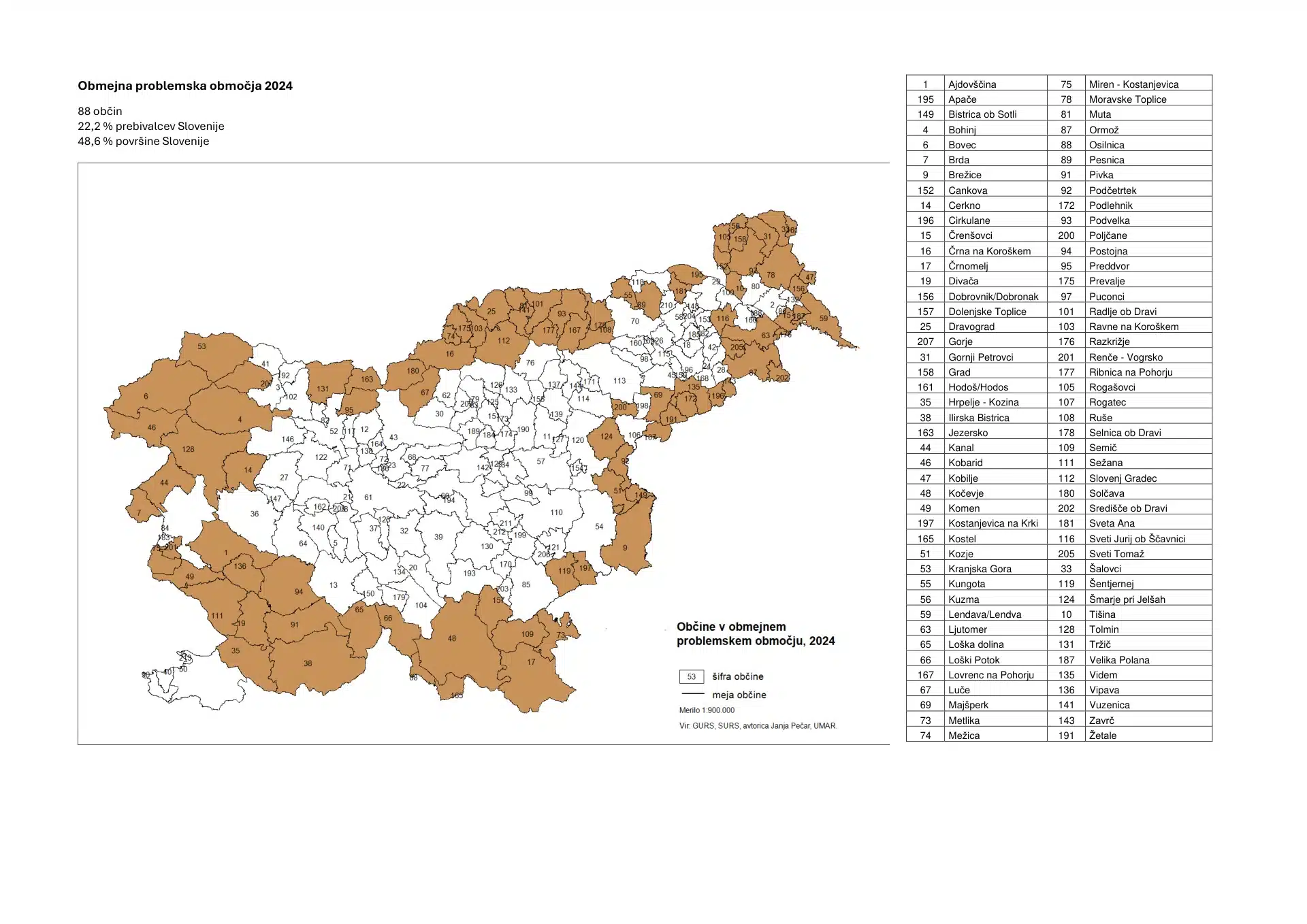
According to official data published by MKRR and UMAR, border problem areas encompass:
- 88 municipalities out of 212 Slovenian municipalities;
- 22,2 % of Slovenia’s total population;
- 48,6 % of the national territory.
Key updates: newly added and removed municipalities
Following the latest statistical reassessment:
- Newly designated municipalities (+3): Ljutomer (code 63), Razkrižje (code 176), and Sveti Jurij ob Ščavnici (code 116).
- Removed municipality (-1): Dornava no longer meets inclusion thresholds.
Official list of 88 municipalities with official codes
The 88 designated municipalities and their official codes (corresponding to the map above) are:
Ajdovščina (1), Apače (195), Bistrica ob Sotli (149), Bohinj (4), Bovec (6), Brda (7), Brežice (9), Cankova (152), Cerkno (14), Cirkulane (196), Črenšovci (15), Črna na Koroškem (16), Črnomelj (17), Divača (19), Dobrovnik/Dobronak (156), Dolenjske Toplice (157), Dravograd (25), Gorje (207), Gornji Petrovci (31), Grad (158), Hodoš/Hodos (161), Hrpelje – Kozina (35), Ilirska Bistrica (38), Jezersko (163), Kanal (44), Kobarid (46), Kobilje (47), Kočevje (48), Komen (49), Kostanjevica na Krki (197), Kostel (165), Kozje (51), Kranjska Gora (53), Kungota (55), Kuzma (56), Lendava/Lendva (59), Ljutomer (63), Loška dolina (65), Loški Potok (66), Lovrenc na Pohorju (167), Luče (67), Majšperk (69), Metlika (73), Mežica (74), Miren – Kostanjevica (75), Moravske Toplice (78), Muta (81), Ormož (87), Osilnica (88), Pesnica (89), Pivka (91), Podčetrtek (92), Podlehnik (172), Podvelka (93), Poljčane (200), Postojna (94), Preddvor (95), Prevalje (175), Puconci (97), Radlje ob Dravi (101), Ravne na Koroškem (103), Razkrižje (176), Renče – Vogrsko (201), Ribnica na Pohorju (177), Rogašovci (105), Rogatec (107), Ruše (108), Selnica ob Dravi (178), Semič (109), Sežana (111), Slovenj Gradec (112), Solčava (180), Središče ob Dravi (202), Sveta Ana (181), Sveti Jurij ob Ščavnici (116), Sveti Tomaž (205), Šalovci (33), Šentjernej (119), Šmarje pri Jelšah (124), Tišina (10), Tolmin (128), Tržič (131), Velika Polana (187), Videm (135), Vipava (136), Vuzenica (141), Zavrč (143), and Žetale (191).
Commercial advantages for enterprises in border problem areas
Tender scoring bonuses (SPS, SPIRIT)
Projects located within OPO territories frequently receive 5 to 15 bonus points in competitive calls by the Slovene Enterprise Fund (SPS) and SPIRIT Slovenia.
Dedicated grant schemes and subsidized SRRS loans
The Ministry of Cohesion regularly issues targeted calls solely for businesses in OPO territories, alongside subsidized credit facilities from SRRS.
Synergy with the Regional Aid Map and cohesion regions
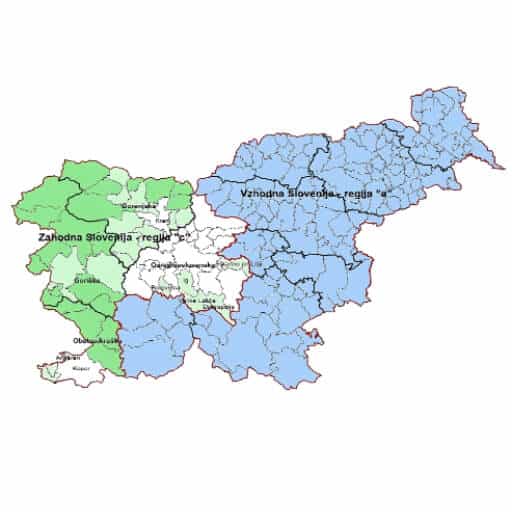
Works in tandem with Slovenia’s regional aid map and cohesion regions.